


Designing space-bound hardware requires balancing rigid structures for dynamic loads with compliant features for thermal expansion – a tricky engineering compromise. The recent proliferation of small satellites means these challenges are being tackled on smaller scales and larger scales (constellations) than ever before. Creaform has risen to meet these needs, with extensive project experience (30+ space projects completed) and a mastery of advanced tools like LS-DYNA for nonlinear transient analysis. From modal and vibration analysis to shock and thermal simulations, our engineering team helps ensure that every component we touch is ready to withstand the extremes of launch and the unforgiving environment of space. By combining technical rigor with practical experience, Creaform Engineering plays a key role in making sure today’s satellites and space systems are both robust and reliable when it matters most.
Space is an exceptionally harsh environment for engineered systems, especially for satellites and spacecraft components. Designing these components requires balancing conflicting demands. During a rocket launch, hardware faces intense dynamic loads – severe vibrations and shocks – which lead engineers to design very rigid structures for survival. Once in orbit, however, the same hardware encounters extreme thermal cycles (drastic temperature swings from sun to shadow), and thermal expansion demands that structures have enough flexibility or allowance to avoid cracking under stress. Managing this rigidity vs. flexibility trade-off is one of the fundamental challenges in space component stress analysis, and it’s a challenge Creaform Engineering team has mastered through extensive experience in advanced numerical simulation.
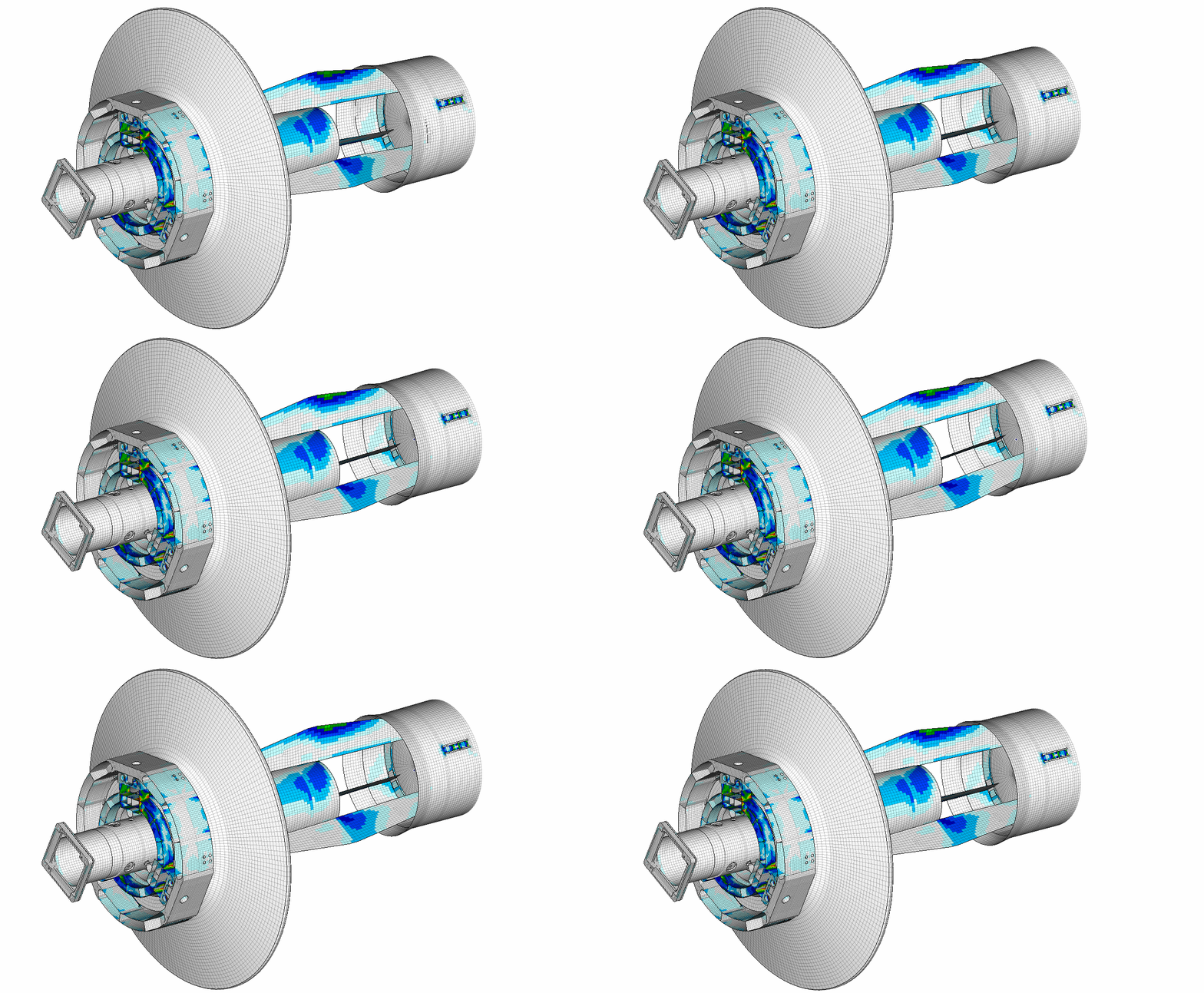
The Rise of Small Satellites and Constellations
In recent years, the satellite industry has seen a dramatic shift toward smaller satellites. Small satellites (from microsatellites down to CubeSats) have become extremely common in modern space missions, often deployed in large numbers to form constellations. These constellations – exemplified by global communication networks – are made up of dozens or even thousands of small, mass-produced satellites working together. For example, nearly 2,900 smallsats were launched in 2023 alone, accounting for about 97% of all spacecraft that year. This trend of miniaturization means that even compact satellites must endure the same punishing launch environment as larger craft, often with tighter mass and cost constraints. Creaform’s expertise is well-suited to this new era: we apply rigorous stress analysis methods to smallsat structures to ensure reliability, despite their size and the high-volume production approach.
Creaform’s Experience in Space Projects
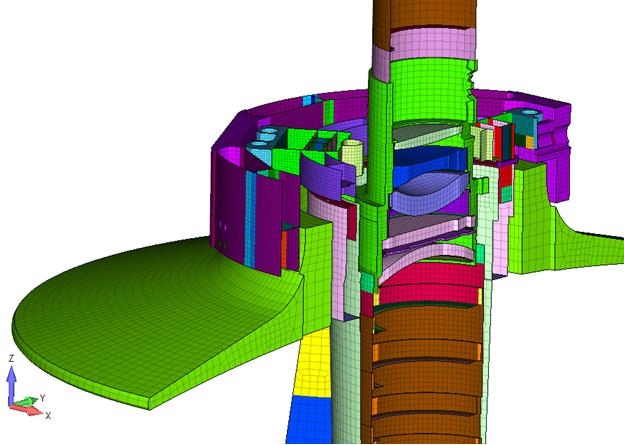
With a multidisciplinary team of simulation specialists, Creaform has contributed to over 30 space projects in the past years. Our portfolio spans from carrying out entire satellite structural analyses to focusing on individual high-precision subsystems. We’ve worked on optomechanical components for space telescopes (e.g. mirror mounts and optical bench structures that must remain stable under stress), antenna deployable mechanisms, satellite electronics and avionics housings, and scientific instruments like spectrometers and interferometers. Each project comes with unique challenges – for instance, an optical telescope component submitted to extreme temperature distribution and flight mechanism actuation must retain alignment to nanometer precision even after surviving launch vibrations. Furthermore, an antenna’s lightweight boom must survive deployment shock and repeated temperature cycles. Through all these projects, our engineers have leveraged advanced Finite Element Analysis (FEA) and Computer-Aided Engineering (CAE) tools to predict structural behavior and validate designs before anything ever flies.
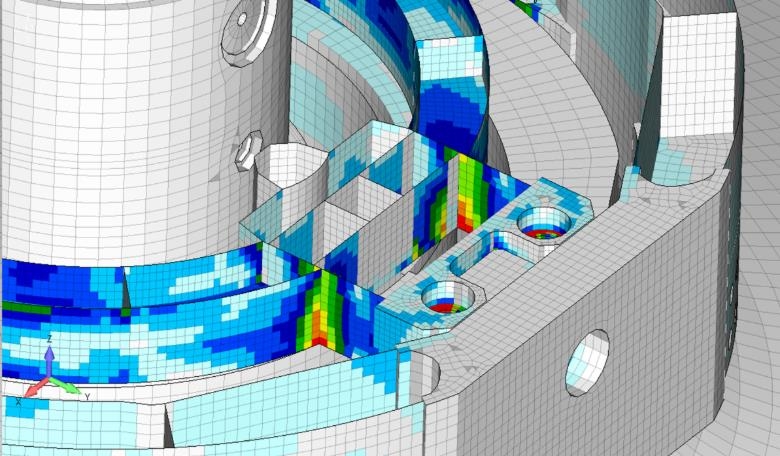
Advanced Vibration and Fatigue Analysis (Modal, Sine, Random)
A key part of our numerical simulation work for space components is vibration analysis. We typically begin with modal analysis, computing the natural frequencies and mode shapes of a structure. For spacecraft, it’s common to ensure that all significant modes are identified up to high frequencies – often up to around 2000 Hz for smaller components or sensitive equipment. This ensures that no important resonance is overlooked, since launch vibration environments can excite a broad frequency range.
We then perform simulations of sine and random vibrations, reflecting standard aerospace qualification tests. In a sine vibration analysis, we apply a sinusoidal load that sweeps through frequencies. This helps identify resonant responses clearly and verifies that the structure can handle specific vibrations (like those from rocket engines or rotating machinery, typically at lower frequency range) without excessive stress or deformation. In contrast, random vibration analysis applies loads across a wide spectrum of frequencies simultaneously, typically represented by a Power Spectral Density (PSD) profile.
Random vibration analysis is critical for simulating realistic broadband vibrations from rocket launches or the variable, probabilistic loads induced by transport on vehicles or cargo. It tends to excite multiple modes simultaneously, accounting for interactions between modes and cumulated effects of the complex vibration environment. Importantly, random vibrations cause cumulative fatigue on components – countless tiny stress cycles that can add up to material fatigue over the launch duration. Using the simulation results, our team predicts cumulative fatigue damage (for example, by techniques such as rainflow counting and Miner’s rule) to ensure that the hardware has adequate fatigue life and won’t crack under repeated vibrational loading.
In simple terms, modal analysis identifies resonant frequencies; sine analysis predicts structural response to specific frequency excitations; and random vibration analysis evaluates how a structure withstands a realistic mix of vibrations and whether it might fatigue or fail after prolonged shaking. Together, these analyses are essential for satellite launch qualification.
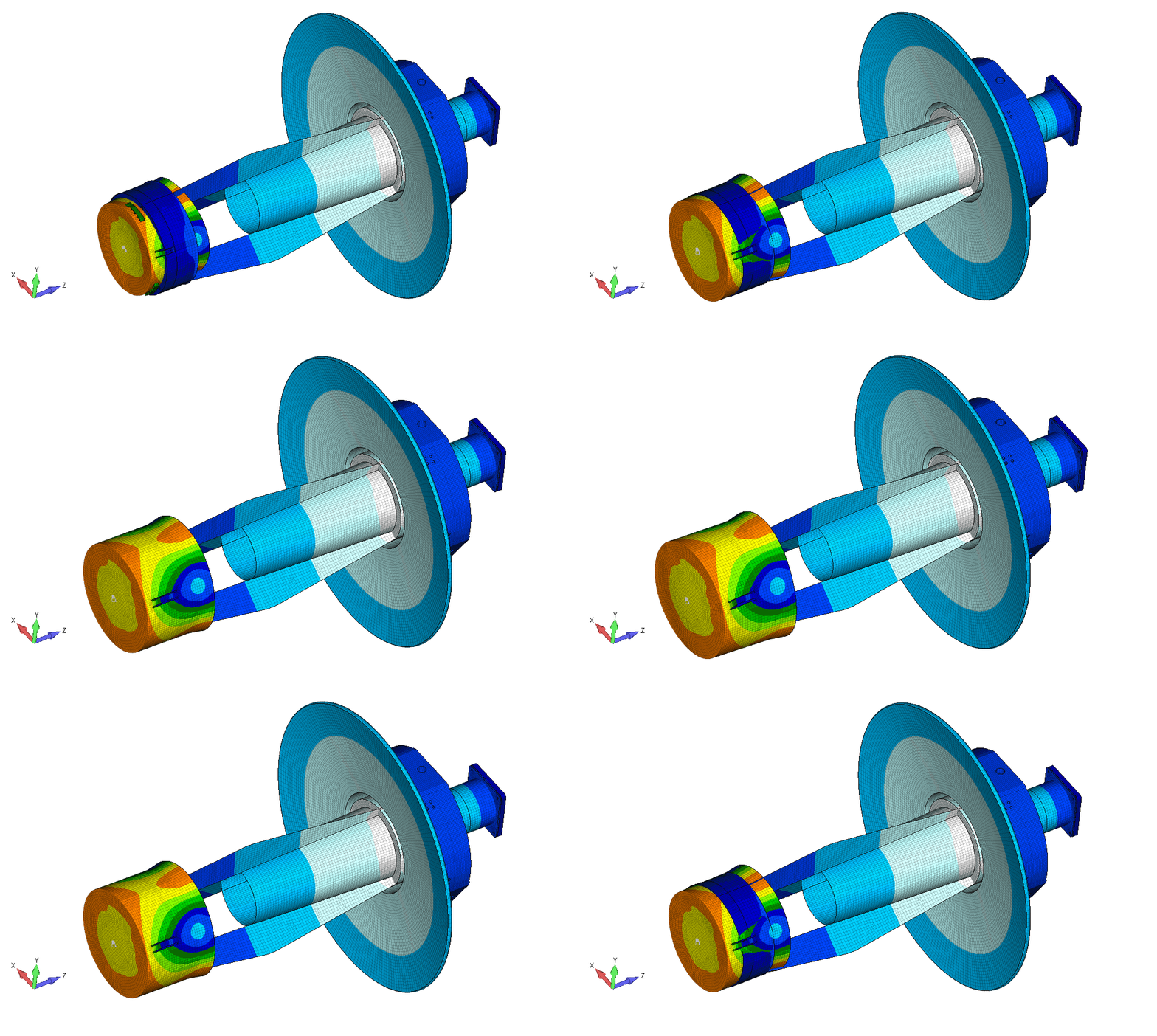
Shock and Transient Analysis with LS-DYNA
Beyond steady vibrations, spacecraft hardware must also survive shock events. During a launch and deployment, short-duration shocks occur – for instance, when stages separate using explosive bolts or when deployable structures (like solar panels or antennae) rapidly unfold and lock into place. These shock events are characterized by very fast, high-magnitude loads – often spikes of acceleration in the order of hundreds or thousands of g’s over just a few milliseconds. Such events are usually analyzed via a Shock Response Spectrum (SRS) in traditional aerospace qualification, which simplifies the representation of a shock by the response of single degree of freedom systems to the original transient input. However, Creaform’s simulation team goes a step further by directly simulating shock events in the time domain using LS-DYNA.
LS-DYNA is a state-of-the-art explicit finite element solver known for handling highly non-linear, transient dynamics – exactly what’s needed for realistic shock and impact simulations. Our engineers are highly specialized in using LS-DYNA for space applications. For example, we have successfully simulated pyrotechnic separation shocks of satellite stages and the transient behavior of deployable structures in fine detail. By modeling the actual time-dependent forces and material responses, we capture effects (like plastic deformations, damping, or multi-component interactions) that simpler linear models might miss. This level of detailed shock analysis gives satellite designers confidence that sensitive components – say, an optical sensor or circuit board – won’t be damaged when a sudden shock runs through the spacecraft.
We also apply LS-DYNA’s powerful capabilities beyond traditional spaceflight scenarios, particularly in the design and validation of ground transportation systems and handling equipment for space components. During manufacturing, integration, and testing phases, sensitive hardware is vulnerable to damage from drops, impacts, and shock events. To mitigate these risks, specialized transport fixtures and manipulators are engineered to isolate delicate payloads from external mechanical loads. LS-DYNA’s ability to simulate complex transient events and model passive isolation systems enables us to optimize these protective devices, reducing the risk of damage and ensuring the safe handling of high-value space assets.
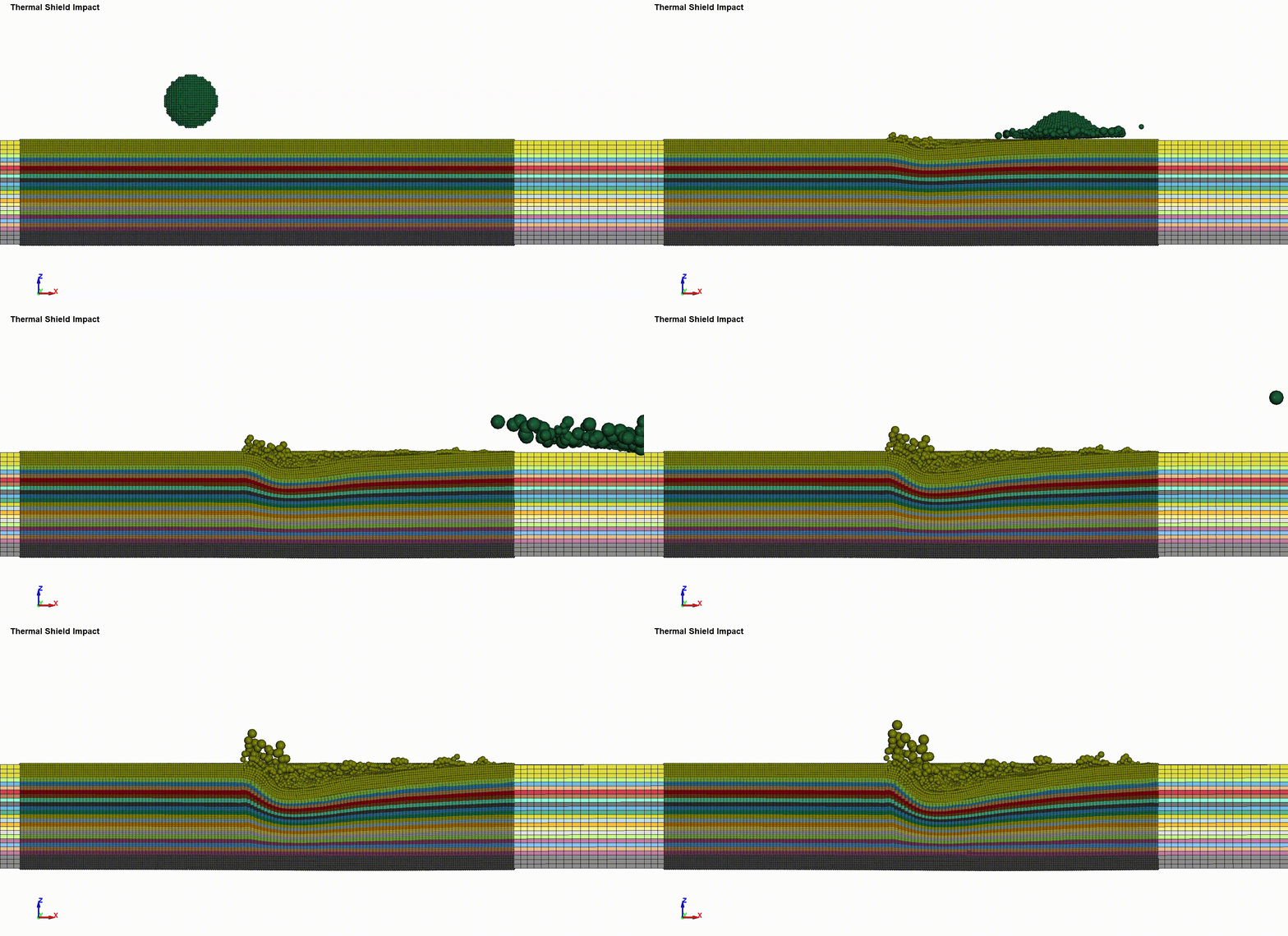
Recently, our team conducted a high-speed impact simulation of protective shielding for a space application, leveraging the advanced modeling techniques honed through our defense-sector experience in armor development. In this case, LS-DYNA was used to predict the structural response of a protective panel subjected to an extreme impact at velocities exceeding Mach 15—demonstrating the software’s ability to capture highly dynamic, nonlinear behavior under severe loading conditions.
Thermal Analysis and Optomechanical Stability
Mechanical loads aren’t the only concern for satellites – thermal stresses are another critical factor. Once in orbit, a spacecraft experiences cycles of heating and cooling: for instance, when a satellite in low Earth orbit moves in and out of the Earth’s shadow every 90 minutes, components can swing from very cold to very hot temperatures. Such thermal swings cause materials to expand and contract. If different materials in an assembly expand at different rates, thermal expansion mismatches can induce significant stresses or distortions.
Creaform conducts detailed thermal analysis and thermal distortion analysis as part of our simulation services for space projects. We simulate the distribution of temperatures across components and how the structures will deform as temperatures change. By inputting thermal expansion coefficients and temperature profiles into our finite element models, we predict thermal deformation and stress. This analysis is particularly important for optomechanical systems like telescopes and cameras on satellites, where even microscopic deformations can misalign optical elements. For example, an instrument might be perfectly aligned on the ground, but in the cold vacuum of space it could contract and introduce misalignments – our simulations help foresee and correct for that. Through thermal-structural coupled analysis, we ensure that designs include proper expansion joints, flexures, or material choices to accommodate expansion without compromising structural integrity or performance. Essentially, we make sure satellites are thermally resilient as well as mechanically robust.
Supporting Startups and Industry Leaders Alike
Creaform’s specialized stress analysis and simulation services cater to a wide range of clients in the space sector. Our customers range from agile startups – which might have limited in-house simulation capabilities – to large international aerospace companies that seek independent, third-party verification of their designs. For a space startup developing its first CubeSat, we can act as an extension of their engineering team, providing key simulations (like dynamics response or thermal distortion analysis) that ensure the satellite will work right the first time.
For established aerospace firms, we offer a fresh, qualified perspective and advanced simulation techniques (such as our LS-DYNA shock modeling) to validate and optimize components that may be mission-critical. In all cases, clients trust Creaform to deliver accurate analysis, clear reporting, and actionable recommendations to improve their hardware.
Share This Story, Choose Your Platform!